
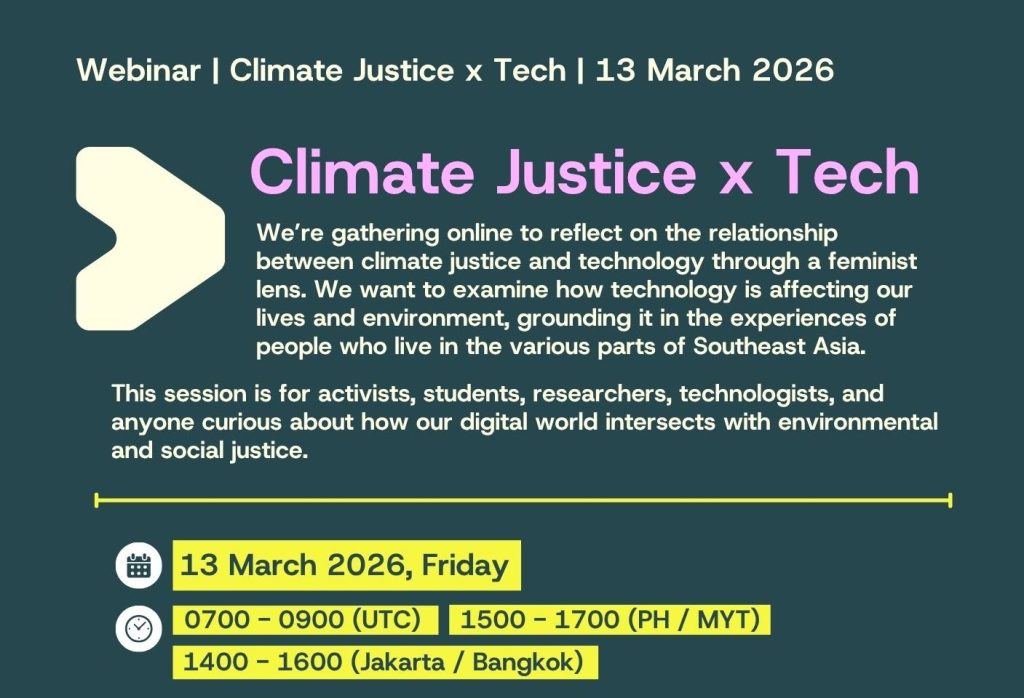
1. Opening
This Webinar on Climate Justice x Feminist is organised by MataSEA, a Southeast Asia transnational feminist tech collective that was formally institutionalised in the year 2024. The collective emerged from a long-standing vision of building a strong and collaborative feminist movement across Southeast Asia. In introducing MataSEA, the moderator, Serene Lim, coordinator and co-schemer of MataSEA, highlighted that narratives from Southeast Asia are often flattened or marginalised within global conversations on technology and digital governance. This initiative aims to strengthen the feminist tech movement in Southeast Asia by facilitating connections, exchanges of knowledge and expertise and fostering collaboration based on feminist principles of care and joy.
Serene shared that this webinar stemmed from a place of curiosity and a desire to deepen our understanding of the impact of technology on climate justice. Many of us have been conditioned to perceive the current tech model – LLM, digital monopolies such as Microsoft, Google etc is normal and inevitable. We are accustomed to a linear design-production-use-disposal-recycling model, where the default thinking is to get a new computer instead of repairing it. Obsolescence is also built into our phones as newer operating systems and apps increasingly demand greater processing power and more advanced hardware. This raises what she described as a “crisis of imagination”: when solutions are limited to the same systems that produced the problems in the first place. And underneath all these techno-empires, there is a full supply chain that is built from consuming monstrous amounts of data, labour, computing power and natural resources from the global South. The webinar, therefore, sought to explore how feminist approaches can help reimagine alternative ways of being and existing along with tech.
The discussants for the session were introduced:
- Dhyta Caturani, co-schemer of MataSEA and founder of PurpleCode
- Madhuri Karak, founder and research lead of beyond Carbon
- Chee Yoke Ling, Executive Director of Third World Network
2. Key Presentations
- Dhyta Caturani
Dhyta began by addressing a common question faced by feminist technology activists: What does feminism have to do with technology?
She noted that people often ask why technology needs to be feminist, or whether technology can even be feminist at all. While discussions about politics, economics, and environmental issues frequently incorporate feminist perspectives, technology is often framed as neutral or apolitical.
Dhyta challenged this assumption. She emphasised that technology is never neutral, particularly within systems shaped by capitalism and colonialism. Modern technological infrastructures are largely developed and controlled by large corporations, many of which are dominated by Western, male-centred leadership and perspectives.
These systems carry embedded biases and operate primarily for profit rather than public welfare.
From a feminist perspective, technology should be understood not merely as a tool but as a space where social relations and power dynamics operate. Just as feminist movements advocate for equality, safety, rights, and liberation in physical spaces, these same principles should apply to digital and technological spaces.
Dhyta also emphasised that feminism is inherently intersectional. Feminist advocacy has historically engaged with a wide range of issues beyond gender identity, including environmental justice and climate struggles.
Technology plays a significant role in climate impacts through its infrastructure, resource extraction, and energy consumption. For this reason, climate justice must be understood as an important dimension of feminist technology work.
“Technology plays a significant role in climate impacts through its infrastructure, resource extraction, and energy consumption.”
She noted that feminist tech does not require a single universal definition. Rather, it should be grounded in feminist values and principles—centred on people, rooted in care, and attentive to the well-being of both communities and the planet.
Ultimately, the conversation about feminist technology should also involve imagining what kinds of technologies we actually want to exist, and what values should guide their design and use.
Reflections on Digital Consumption
Serene reflected on how technological practices have changed over time. She shared an example from her experience growing up with film cameras, where each photograph required intention and care. Today, digital photography and cloud storage allow for constant and seemingly limitless data accumulation.
While such practices may appear harmless, they have material consequences. Every uploaded photo requires storage infrastructure somewhere in the world, contributing to the expansion of data centres and energy consumption.
Dhyta added that digital platforms are often presented as “free,” but in reality, they operate through systems of data extraction, surveillance, and control. The digital ecosystem relies on complex supply chains and infrastructures that are rarely visible to users.
“The digital ecosystem relies on complex supply chains and infrastructures that are rarely visible to users.”
She emphasised the importance of mapping the full supply chain of technology, asking critical questions such as:
- Who holds power in technological infrastructures?
- Where do the resources come from?
- Do communities benefit from resource extraction, or are they exploited?
- Are workers fairly compensated?
These questions reveal the deep economic and political systems underlying everyday technological use.
2.2 Madhuri Karak
The AI Supply Chain: Climate Justice and Technology
Madhuri’s presentation focused on the environmental and political implications of artificial intelligence systems, particularly through the lens of supply chains.
She began by clarifying that not all forms of AI have the same environmental impact. Many forms of AI have existed for decades, but the rapid expansion of generative AI systems has significantly increased demand for computational resources.
“…the AI supply chain is not linear and does not belong to a single industry.”
Generative AI models require vast amounts of computing power, which translates into high energy consumption and significant water usage for cooling data centres. The scale of these impacts varies depending on the size of the model and the ambitions behind its development.
Madhuri explained that the AI supply chain is not linear and does not belong to a single industry. Instead, it intersects with and draws resources from many other sectors, including:
- Mining and mineral extraction
- Semiconductor manufacturing
- Energy production
- Data center infrastructure
- Global logistics and labor networks
In this sense, the AI industry operates parasitically across multiple supply chains.
Every interaction with AI systems—such as sending a prompt to a chatbot—relies on data centres where large amounts of energy and water are consumed and emissions are generated.
“Existing social inequalities frequently shape where these infrastructures are located, meaning vulnerable communities bear disproportionate burdens.”
Communities living near these infrastructures often experience health and environmental impacts, including noise pollution, air pollution, and increased resource pressure. Existing social inequalities frequently shape where these infrastructures are located, meaning vulnerable communities bear disproportionate burdens.
Madhuri noted that resistance to these supply chains currently exists in many places, particularly in movements opposing mining operations or land grabbing. However, these movements are often fragmented and localised, focusing on specific industries rather than connecting them to broader technological infrastructures.
As a result, the material links between technologies like AI and extraction industries such as lithium or nickel mining are not always widely recognised.
“…the material links between technologies like AI and extraction industries such as lithium or nickel mining are not always widely recognised.”
She emphasised the need to build broader coalitions and shared narratives that connect these struggles under a larger framework of technology justice.
Madhuri also addressed the common argument that AI innovations will help solve the climate crisis. While AI is often framed as a tool for sustainability, many of its current implementations are highly resource-intensive and contribute to emissions in the present.
Finally, she discussed the difficulty of building governance frameworks for AI due to several factors:
- Environmental regulations differ across industries and countries
- AI legislation tends to focus on privacy and security rather than sustainability
- Governments often avoid strict regulation out of fear of slowing technological innovation
- Big technology companies hold significant influence over policymaking
Addressing these issues requires strong civil society engagement and sustained counterpower in a deeply unequal technological ecosystem.
2.3 Chee Yoke Ling
Structural Inequalities and Technological Development
Yoke Ling emphasised the importance of recognising the structural power inequalities embedded within technological systems.
She noted that feminist analysis often centres on confronting power imbalances, and this framework can also be applied to understanding the political economy of technology.
“…feminist analysis often centres on confronting power imbalances, and this framework can also be applied to understanding the political economy of technology.”
Drawing from historical experience in the Global South, she highlighted how colonial and postcolonial dynamics continue to shape technological development and resource extraction.
Yoke Ling also questioned the language of “technological revolutions,” noting that several waves of innovation—including biotechnology, genetic engineering, and information technologies—have been promoted as transformative solutions to global problems.
However, many of these developments have also intensified environmental destruction and social inequality.
She argued that technological change has frequently been framed as progress, particularly in narratives that portray industrialisation as an improvement over agriculture. Yet this framing overlooks the environmental and social costs associated with such transitions.
“She argued that technological change has frequently been framed as progress…Yet this framing overlooks the environmental and social costs associated with such transitions.”
Another critical issue is the scale of technological control. A small number of powerful corporations and individuals dominate the global technology sector, concentrating economic and political influence.
Many of these corporations invest heavily in lobbying and political influence to prevent meaningful regulation.
Yoke Ling stressed that the goal is not to blame individuals who use digital tools, since many people rely on them out of necessity. Instead, the challenge is to question the broader systems that normalise technological solutions without examining their underlying power structures.
“the challenge is to question the broader systems that normalise technological solutions without examining their underlying power structures.”
She also warned against the idea that all technological solutions are inherently beneficial. In some cases, communities may decide that certain technologies are not appropriate for their social, cultural, or ecological contexts.
Ultimately, she called for deeper reflection on how societies define technology itself and encouraged participants to reimagine technological development in ways that prioritise people, communities, and ecological sustainability.
3. Discussion and Question & Answer
During the open discussion, participants reflected on historical trends in technology-driven development. One participant noted that previous development paradigms often promoted information and communication technologies (ICTs) as universal solutions to social problems, from water management to public health initiatives.
The current emphasis on AI appears to follow a similar pattern, where new technological tools are continuously proposed as solutions to complex societal challenges.
Participants also discussed how corporate power remains highly concentrated in the technology sector, allowing major companies to maintain significant influence over policy and global governance.
The discussion highlighted the importance of historical context in understanding contemporary technology debates.
Another participant suggested expanding existing mapping tools related to the AI supply chain to include feminist and climate justice perspectives, allowing activists and researchers to collectively annotate and analyze these systems.
4. Mapping Exercise and Reflections
Participants engaged in a brief reflection on mapping exercises related to global technology infrastructures.
Observations included:
- The dominance of United States–based technology corporations in the global landscape
- The rapid rise of China as a technological competitor
- The absence or underrepresentation of certain regions, such as West Asia, in discussions about data centre infrastructure
Participants also reflected on funding dynamics within civil society organisations. In some cases, advocacy priorities have historically been shaped by funding sources, including technology companies themselves.
Recent geopolitical shifts have prompted organisations to reconsider their funding structures and rethink how movements can maintain independence while sustaining their work.

Map sourced from: https://www.cartografiasdainternet.org/en
A participant from the film and media industry shared concerns about the increasing pressure to adopt AI tools in creative production. While AI technologies are becoming integrated into creative workflows, there are also concerns about how these tools draw from cultural materials without proper attribution or respect for Indigenous communities.
In regions such as Borneo, communities continue to face barriers in telling their own stories due to unequal access to resources and representation within national media industries.
AI-generated imagery has sometimes replicated Indigenous cultural motifs inaccurately, raising concerns about cultural appropriation and misrepresentation.
At the same time, some communities are experimenting with AI tools as a way to visualize and express their identities. This creates complex ethical questions about how to approach technological tools that may simultaneously enable creativity while also reinforcing extractive systems.
5. Reflections and Conclusions
Participants concluded that conversations on climate justice and technology must remain intersectional, interdisciplinary, and grounded in lived realities.
There is a growing recognition among technology justice advocates of the material infrastructures behind digital systems and their environmental consequences. However, stronger collaboration between movements—including feminist, environmental, labour, and Indigenous struggles—is still needed.
The discussion emphasised the importance of:
- Decolonising technological narratives
- Strengthening regional feminist technology networks
- Connecting localised struggles against extraction and infrastructure expansion
- Imagining alternative technological futures rooted in care, justice, and sustainability
Dhyta concluded by noting that within many feminist movements, technology is still not widely recognized as a core political issue. Integrating technology into feminist agendas remains an ongoing challenge, but also an essential step toward building a more just and equitable digital future.
“Integrating technology into feminist agendas remains an ongoing challenge, but also an essential step toward building a more just and equitable digital future.”

 MataSEA